


I show you how to roast chestnuts in the oven by using raw store-bought chestnuts from the grocery store. Roasted chestnuts are a lovely, healthier snack, which is commonly served in winter during the Christmas time.

Global Food Recipes
with Spices and Herbs
Free E-Book available for a limited time. Grab yours now and get instantly inspired!
You missed out!
Jump to:
What are Chestnuts?
Chestnuts are edible, sweet nuts that are surrounded by a dark brown shell and paper-like skin. Chestnuts are common in Europe, Japan, China, and the North American continent and are known as holiday wintertime food.
You can purchase these seasonal nuts from the end of September up to January (depending where you live). The nuts can be purchased at Christmas markets in Europe and are eaten as is without seasoning or sugar.
The best chestnuts are moist and soft but have a mealy consistency, like a potato. The light brown/beige nut on the inside tastes unique and cannot be compared to anything, yet when they are roasted, they turn out sweet.
Chestnuts are also known as Maroni or edible Kastanie. I have to point out that the sweet edible chestnut shouldn't be confused with the horse-chestnuts (aka conkers), which we shouldn't consume. Yet they look alike!

Origins
Chestnuts most probably originated in the Mediterranean area. However, the nuts are a common winter street food in Italy, Austria, Switzerland, Germany, and even in New York (US) during Christmas time.
The chestnuts are roasted over an open fire at Christmas markets or in open streetcars. In France and Japan, they are called Maroni and they are turned into a paste for Swiss roll roulade.

Choice of Chestnuts
There are three major varieties of chestnuts, the native American, the European, and the Asian (Chinese) chestnuts. You can pick any of those to roast. The nuts are in season in fall/winter and should only be bought and consumed at that time.
Grocery stores may sell them all year round, but those chestnuts are not that great and should be avoided. So buy and consume chestnuts when they are in season from September to January. It's difficult to tell on the outside when the nuts were picked, and I had some occurrences where I bought the wrong ones.
You see bad and spoiled chestnuts can only be spotted after you open them (which is often while right after you have roasted them), because they are moldy between the shell and the skin.
This is why I like to buy raw chestnuts from a reputable source where I know that I won't be disappointed. Quality chestnuts are sometimes difficult to come by and can make a huge difference, but they will make it easy to peel.
Prepping Raw Chestnuts
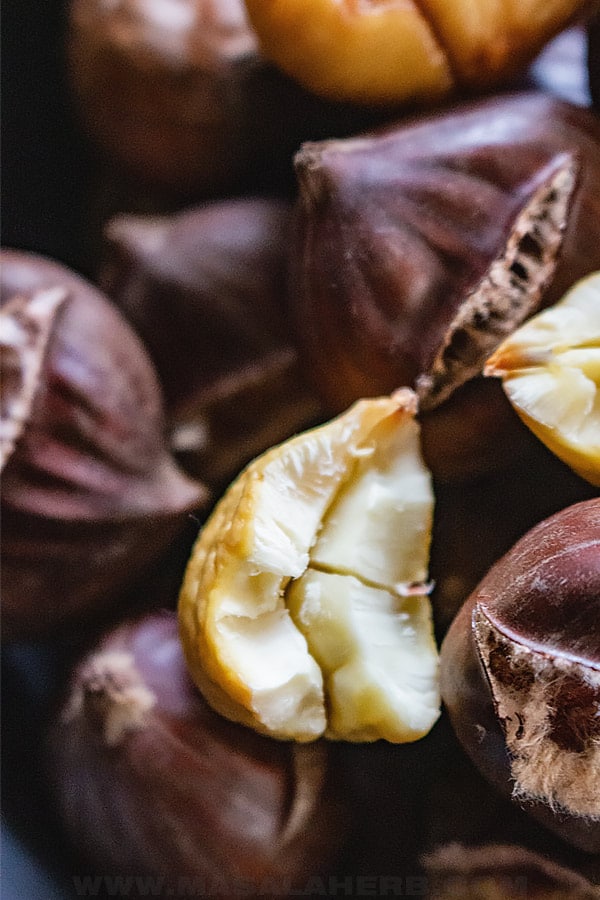
You won't need much at all to prepare your chestnuts to roast. The raw chestnuts require a cut on the flat surface so that they cook through properly and so that the nuts can expand on the inside when they get roasted.
Take a knife and make a cut across the chestnuts with the dull knife heel or with a bread knife (don't cut yourself!). One cut is more than enough, but you can also make a cross (which is an old method).
Most folks tend to cut only once across the chestnut shell in Europe because anything more is not necessary. The chestnuts are then kept in water to soak, as this helps in retaining the moisture level in the nut during the roasting.

Roasting the Chestnuts
To roast chestnuts in the oven, place your dried chestnuts on a lined sheet with parchment paper. Roast your chestnuts at 350 Fahrenheit/ 180 Celsius for about 20 - 25 minutes or until they are roasted through.

Peel to Eat Chestnuts
A roasted chestnut is peeled by removing the dark brown outer shell and the papery skin on the chestnut. You can use a serrated knife for that. A great way to prepare your cooked chestnuts for peeling is to place them into a damp cloth when they are still hot. That way the skin will detach easier from the chestnuts.
Furthermore, keep in mind that tough-to-remove chestnut skin can also have something to do with the fact that the nut was lying around over an extended period of time and that it's not all that fresh anymore.
The quality and freshness of your nuts are also good indicators if the skin is difficult to peel off from the edible chestnut part.

📖 Recipe

How to roast chestnuts
Ingredients
- 30 piece Chestnuts raw in the shell
- Water
Instructions
- Make a cut with the heel of your knife across the chestnut. Only one cut is needed and not a cross-cut. *See Notes
- Place cut chestnuts into a bowl and cover with water. Make sure the nuts are submerged. Leave the nuts to soak for at least 30 minutes.
- Preheat your oven to 350° Fahrenheit/ 180° Celsius just before you intend to roast your nuts.
- Take your chestnuts out of the water and pat them dry with a clean kitchen cloth.
- Spread the nuts over a tray lined with parchment paper.
- Roast your chestnuts at 350° Fahrenheit/ 180° Celsius for about 25 minutes or until they are cooked through. *See Notes
- Allow your nuts to cool after they have been roasted and peel by removing the shell and the skin surrounding the chestnut.
- Enjoy as a snack as is or use further in your food.
Notes
- We found that one cut across the chestnut is more than enough to roast the chestnuts. We used to cut in a cross but it's not required. Besides we found that cutting in a cross, makes the nuts to turn out more dry You can choose to just cut once or to cut in a cross.
- Roasting time might vary. It depends on the size and quality of your chestnuts.
Nutrition
Storing
The nuts are best consumed right after roasting. However, you can store roasted and cooled chestnuts for up to 2-3 days in your fridge in the shell or deshelled. Keep them in an airtight container until further use.

FAQs
I have never eaten chestnuts raw, and I don't know anyone who has.
You don't have to, but I recommend it because chestnuts can get a bit dry when roasted in the oven. To retain the moist buttery taste, I choose to soak them for at least 30 minutes first.
Depending on the size, quality, and age of your chestnuts, roast them for about 25-20 minutes in the oven at 350 Fahrenheit/ 180 Celsius
Edible chestnuts are never bitter. Only horseshoe chestnuts are bitter, and those cannot be consumed. However, horseshow chestnuts almost look like the edible chestnuts and shouldn't be confused!
The outer dark brown shell and the papery skin on the edible chestnut have to be peeled off. The paper skin in some chestnuts can be difficult to peel off, and occasionally they just come off easily. A trick is to keep your chestnuts in a damp towel when they are still hot because this can help in removing the tough skin. Chestnuts can be challenging to peel too if they are too old or of poor quality.
More Chestnut Recipes
- Yule log (Buche de Noel) with chestnut cream filling
- Baking chestnuts for stuffing - just add your nuts to your stuffing
- Roasted chestnut soup
- Thanksgiving stuffing cup by playpartyplan.com

Comments
No Comments